Family estrangement: when things don't add up

When we think about family, we tend to see it as something permanent – a bond that is expected to last a lifetime. Yet estrangement is increasingly common, and the emotional reality of it is often misunderstood.

I understand this deeply, both through my work and personal insight, and have seen how its impact can extend far beyond the immediate relationship, affecting siblings, grandchildren, wider family members, and sometimes even close friends.
How estrangement can develop over time
In my experience, estrangement often develops gradually. It can creep up on a person, sometimes without a clear awareness of how the other is feeling, or what may be building beneath the surface.
It isn’t always marked by a single defining moment, such as an argument or a difference of opinion. While some relationships do end abruptly, many shift slowly over time until the connection breaks down.
In many cases of estrangement, there is no single truth. Each person is deeply rooted in their own experience of the relationship, and in the story they have come to understand as “what happened.”
It can feel easier to view the other as entirely at fault than to sit with the more uncomfortable reality of mixed and often conflicting feelings. In this sense, estrangement can become something of a fixed position, where blame holds weight, and perspectives become increasingly one-dimensional.
On one side, there may be a genuine sense of needing distance in order to feel safe or protected. On the other, there can be confusion, rejection, or even a feeling of betrayal, alongside a strong pull to make sense of what has happened. This can leave the relationship in a state of emotional standstill, where neither side feels heard or understood.
The emotional impact of estrangement
What is often shared, however, is a deep emotional impact. Both may be grieving the same sense of loss, but from very different positions. The experience can feel heavy, unresolved, and difficult to move forward from, leaving a gap in a person’s sense of their own life story.
The emotional impact of estrangement can be complex and, at times, difficult to put into words. Unlike other forms of loss, there is often no clear ending or shared acknowledgement of what has happened. The relationship exists in a kind of in-between space, neither fully present nor fully gone.
This can give rise to a form of ongoing grief. There may be unanswered questions, conversations that never took place, and a persistent sense of “unfinished business.” For some, there is a constant pull to make sense of what happened; for others, a need to step away from that questioning in order to cope.
Mixed emotions and identity
Feelings can be mixed and, at times, conflicting. Alongside sadness or loss, there may also be relief, particularly where the relationship had become strained, difficult, or emotionally unsafe. This combination of emotions can feel confusing and sometimes hard to admit, even to oneself.
Estrangement can also affect how a person sees themselves. Family relationships often form part of our identity, and when those connections are disrupted, it can leave people questioning their place, their role, and their understanding of their own story.
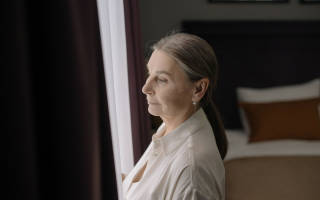
It may bring a quiet sense of disorientation, of not quite knowing where you stand, or how to make sense of what has been lost. This can shift how a person relates not only to their family, but to themselves. Over time, this can feel like carrying something unresolved – a quiet absence that sits in the background of everyday life.
Why reconciliation can feel difficult
Estrangement is often difficult to resolve, not because there is no desire for change, but because the emotional ground beneath it is rarely stable. By the time contact has reduced or stopped, both sides may feel hurt, misunderstood, or guarded in ways that make reaching out feel risky.
For some, distance comes after a long period of trying to make sense of the relationship – asking questions, seeking clarity, or attempting to repair what feels broken. When those efforts don’t lead to answers or understanding, stepping back can begin to feel like the only way to find some sense of peace, rather than continuing in a cycle that feels unresolved.
From another perspective, that same distance may feel sudden or confusing, particularly if there has been little shared understanding of what led to it. This can leave the other person searching for meaning, or feeling shut out of a process they don’t fully understand.
Over time, each person can become more certain of their own perspective. Attempts to explain or repair may be met with defensiveness, silence, or further distance, reinforcing the sense that resolution is either impossible or unsafe. What might once have been a relationship with flexibility can become fixed, with both sides holding firmly to their version of events.
There can also be an internal conflict. A part of someone may long for connection, while another part feels the need to protect themselves. This push and pull can leave people feeling stuck, unsure whether to reach out, step back, or remain where they are.
For many, the question is not simply how to reconnect, but whether reconnection is possible, or even right, given what has taken place.
Where therapy fits
When estrangement reaches this point, people often find themselves searching for answers, trying to make sense of what has happened, what it means, and what, if anything, can be done next.
Therapy can offer a space to begin exploring this, but not in a way that looks for a single explanation or places fault entirely in one direction. While understanding past experiences can be helpful, focusing solely on identifying who is “right” or “wrong” can sometimes keep people feeling stuck within the same patterns of thinking.
Therapy can offer space to explore how each person has come to understand the relationship, the meanings they have made, and the emotional impact it continues to have. This allows space to explore not only what has happened, but how it is being held and experienced in the present.
For some, this may lead towards finding a way to reconnect. For others, it may involve coming to terms with distance or finding a different kind of resolution that feels more manageable.
What matters is not reaching a particular outcome, but developing a clearer understanding of oneself within the situation, and finding a way forward that feels considered, rather than reactive.
At times, estrangement can begin to feel deeply personal, as though the distance says something about who they are. This can affect a person’s sense of identity, leaving them unsure of their place, their role, and how to make sense of their own story. For each person, what comes next will look different. But when there is a chance to step back from reacting in the moment, even slightly, things can begin to ease, however small.

Find the right counsellor or therapist for you
All therapists are verified professionals