Therapy outdoors: why nature changes what's possible

My first-ever client asked if we could move our session outside. I remember being surprised – it hadn't occurred to me that this was even something you were allowed to do – and slightly nervous about asking my supervisor whether there was a clinical case for it.
She said yes. So one torrentially wet August afternoon, we stepped out into the local park and, in a single session, got further than we had in the previous ten put together.
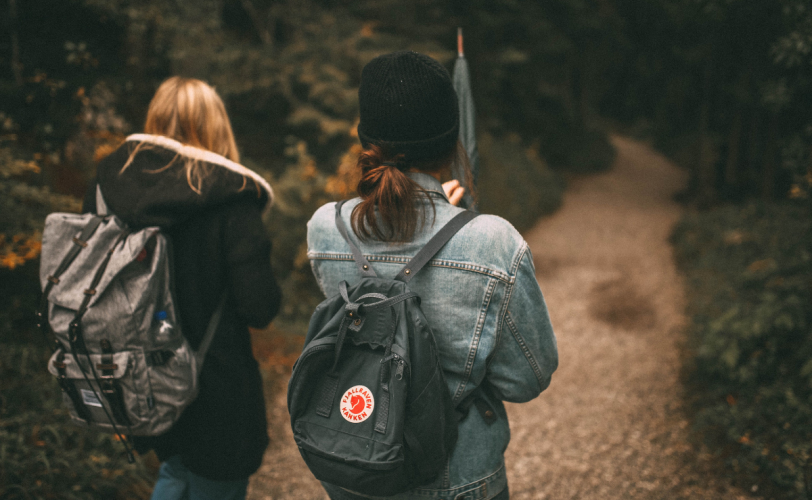
I've never really stopped since. I want to try and explain why, because "it's nice to be outside" undersells it rather badly, and there's more going on here than fresh air and a change of scenery.
Why walking side by side can make talking easier
Start with the obvious: two people walking side by side is a fundamentally different proposition to two people facing each other across a room. There's no held eye contact to manage, no interrogation-room geometry, no visible face registering every flicker of your discomfort back at you.
Something about that arrangement – shoulder to shoulder, moving forward together rather than sitting in stillness, opposite – seems to let difficult things surface more easily, with less bracing beforehand.
This tends to be true for a great many people, not only men, though it does seem to land particularly well for those of us who've grown up learning that sitting still and locking eyes with someone while discussing our feelings is roughly the most exposed a person can be.
How nature can support mental wellbeing
Then there's what nature itself appears to be doing to us, quite apart from the conversation.
There's a well-established idea in environmental psychology called attention restoration theory, which suggests that natural environments engage our attention gently, through what researchers call 'soft fascination' – clouds, leaves, the movement of water – in a way that lets the more effortful, directed part of our attention rest and recover. Compare that to the constant, demanding, foreground noise of a city street, or a phone screen, both of which occupy the same faculty far more forcefully.
Separately, a well-known Japanese line of research into shinrin-yoku, or ‘forest bathing,’ has found measurable drops in cortisol and shifts in immune markers after time spent among trees, though it's worth being honest that quite how much of that translates into lasting change, versus a pleasant but temporary dip in stress, is still genuinely being worked out.
There's also something happening to the talking itself. A well-cited Stanford study found that walking measurably boosts creative thinking compared to sitting, in the moment and shortly afterwards. Whether that's the movement, the environment, or some combination of the two remains a little unclear, but anecdotally it maps neatly onto something I notice constantly in sessions: people arrive at insights out on a walk that I don't think would have surfaced sitting in a chair, staring at me, waiting to be asked the next question.
But underneath the research, there's something older and harder to measure that I don't want to leave out, because it matters to me even if it resists being tidily footnoted.
Finding a new perspective through outdoor therapy
Human beings spent the overwhelming majority of our history outdoors, and something in us still seems to recognise it as home even after a couple of centuries spent mostly indoors.
Every tradition I can think of that takes transformation seriously (pilgrimage, retreat, the wilderness period before a calling begins) seems to reach the same conclusion independently: that something in us shifts differently out there than it does inside four walls. I don't think that's coincidence, and I don't think it's only metaphor either.
Some of that, I suspect, is what researchers studying the phenomenon of ‘awe’ have started to describe: those moments – a huge sky, an old wood, weather doing something bigger than you – that seem to shrink our sense of self for a moment, quiet the internal monologue, and put whatever we've been carrying into a larger, less claustrophobic context.
Shame in particular thrives on a kind of tunnel vision: the conviction that your problem is the whole world, and you are the whole problem. Standing under something genuinely vast has a curious way of loosening that grip, if only briefly. I don't fully understand why. I'm not sure anyone does yet, with any precision. But I've watched it happen often enough, in myself and in the people I work with, to trust that it's real.
So when I say I take therapy outdoors, I don't just mean it's pleasant, or that it helps some people relax before the 'real' work starts indoors. I mean I think it changes what's possible in the room, or rather, in the absence of a room.
The talking still matters. The relationship still does the heavy lifting, as it always does. But out there, both of those things seem to move that little bit more freely, held by something older and larger than either of us.
How to find an outdoor therapist
If you're thinking that this all sounds a bit niche, the good news is that, since the pandemic, this way of working has become increasingly popular. So if you are seeking support and either feel put off by the idea of doing therapy in a room, or are simply drawn to the idea of integrating your therapy with the natural world, there is a large and growing population of counsellors, psychotherapists and coaches who have taken their work outdoors.
Some, like myself, specialise in this way of working, whilst many more offer it as an option for those who feel more suited to operating in this medium. When searching, look for terms such as walk-and-talk (by far the most commonly used), eco-therapy, nature-therapy, nature-based therapy or green therapy alongside any other keywords related to the issue you would like support with.
Many online directories such as Counselling Directory now include one or more of these as a distinct category, which can further help you in the midst of what can be a confusing (if not overwhelming) process of finding the right professional for you at this time.

Find the right counsellor or therapist for you
All therapists are verified professionals