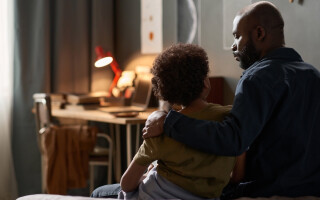
'I’m fine': how divorce really affects men

You're probably not reading this because you feel sad. More likely it's three in the morning, and the TV is on again. Or you've noticed the third glass of wine has become a habit, or you snapped at someone you love over something that didn't deserve it. The house sale has stalled, the solicitor's emails keep coming, and you've told everyone you're fine. Mostly, you are. You're getting on with it.

I work with a lot of men going through separation and divorce, and very few of them arrive saying they're grieving. They come about drinking, temper, sleep, anxiety, or a hard-to-place feeling of being cut off from everyone. The divorce gets mentioned as admin, something to get through.
I'd like to suggest another way of looking at it. What follows are observations from my counselling room, and from five years of bereavement work before that.
Why divorce can land differently for men
Divorce is hard on everyone. Women can face challenges that men may not experience in the same way. Some come out of it worse off financially, and many take on more of the day-to-day load with children. If you're a woman reading this, a lot of what follows will still apply to you. Still, a few things tend to shape the experience differently for men.
In my experience, it’s often the woman who notices first that something is wrong in marriages between men and women. She might be more likely to have talked it through with friends, family or a therapist long before anything is said out loud. Research by Stanford sociologist Michael Rosenfeld found that married women tend to rate their relationships less happily than their husbands do.
Many men don't notice, or notice and keep going, hoping it will right itself. That isn’t true of every couple, and plenty of men see it coming. But whoever makes the final decision, a man can often find himself at the very start of a loss his partner is already well into. From his side, she can seem cold. From hers, he can seem in denial. Often it’s two people on very different timetables.
A word on same-sex divorce
The pressure to cope quietly can come with being a man, no matter who you marry. My experience is primarily with men divorcing women, and I don't want to pretend it all carries across. Same-sex divorce can be less visible, so the support around it can be too. If you're a man who is going through or has been through a same-sex divorce, much of what follows may still apply to you too.
Lonely, and not saying so
Separation is lonely for most people. For men, it can be lonely in particular ways.
Many women might come out of a marriage with a network already around them: friends they talk to properly, other mums from the school gate, their own family perhaps. Plenty of men might find their social life was organised through their marriage, or built around doing things rather than talking. The mates might still be there for the pub or the sports; they're just not the ones you'd tell you can't sleep at night.
There's often shame mixed in. A lot of men grew up with the idea that a 'proper' man provides. He holds his family together and doesn't lose his marriage. When it ends, it can feel like a personal failure as much as a loss, and failure is hard to admit to yourself, let alone anyone else.
Then there's knowing what you feel in the first place. If you've never had much practice at it, the feelings are hard to name. Many men know something is wrong without recognising it as sadness, fear or loneliness. For some, it might be handled in other ways: a joke, a "fine, thanks", longer hours, more drink, drugs, a run of casual sex. None of that makes you a bad person. It's what people do with feelings they don't yet have words for, and finding the words is a big part of what counselling is for.
It's the small things that get you
One of the oddest things men tell me is that they coped with the big losses. The job, the marriage, the family home. Then something small totally floors them, like a text in a certain tone, an old photo, a street they now go out of their way to avoid.
Big losses come with paperwork, deadlines and things to sort out, and all that doing gives the feeling somewhere to go, or somewhere to hide. Small moments turn up with no task attached and the grief you parked arrives all at once.
For some men, it arrives as anger. Many grew up hearing “boys don’t cry” and “be a man”, especially those of a certain generation. Sadness, hurt and fear weren’t allowed, but anger was, so anger became the outlet for every heavy feeling. The psychologist Ron Levant calls this normative male alexithymia. Alexithymia means difficulty putting feelings into words. He calls it normative because he considers it so widespread among men due to how boys are raised that it’s rarely seen as a problem at all.
Many women might have learned the reverse and find themselves crying when they’re angry, because growing up as girls, the expectation was that they should be nice or gentle. Anger wasn’t thought ladylike. Research on depression backs this up: men are more likely than women to show it through irritability, anger, drinking and risk-taking, rather than obvious sadness.
So if you’ve had a flash of rage over something and felt ashamed afterwards, it may well have been sadness in the only form it was ever allowed to take. It could well be grief that hasn’t found anywhere else to go.
Separate the losses
We talk about divorce as one event. In practice, it's several losses stacked on top of each other.
There's the person. There's the relationship, which isn't quite the same thing. There's the home, the pet, and often the everyday contact with your children. There's the future you'd planned, which might include children you never had or a retirement you'd already pictured. And there's the version of you that belonged to the marriage.
Held as one single lump, that's far too much to feel at once. Early on, I help clients pull the losses apart and name each one. It sounds almost too simple, but in practice it changes a lot. Each loss can then be grieved at its own pace, and you’ll start to notice you're further along with some than with others.
Keeping quiet isn't keeping the peace
A lot of men going through divorce settle on a strategy that looks sensible. Keep your head down, don't react, get it signed. If your ex is angry, let it wash over you. If they're being unreasonable, go along with it. It'll be over soon.
I understand why. With the house, money, or time with your children at stake, staying calm can feel like protecting them. And you really can't control how your ex-partner feels. What you can do is stay in touch with how you feel, rather than soaking up their feelings or fighting them.
But calm and passive are different things. Many men believe they're avoiding conflict when, in fact, they're living with it full-time, on the inside. The resentment doesn't disappear. It turns up at 2 am, in the extra drink, the short fuse with someone who had nothing to do with it, or a nagging feeling of despondency.
When a separation keeps stalling, with progress followed by another row over something small, the arguments may be a way of holding on to the relationship. For some couples, arguing is the last bit of contact left (and at this point perhaps the most familiar) and settling the fight means letting the relationship end properly. Spotting that won't make it go away, but it does make the stalling easier to understand.
It’s not a midlife crisis
Plenty of the divorcing men I see use the phrase 'midlife crisis' about themselves, half joking. The guitar comes down from the loft. Football is back on a Saturday. They find themselves in the pub they drank in before they got married, and feel faintly embarrassed about the whole thing.
I see it differently. Long relationships shape us quietly. You make room for another person's tastes, habits and standards, and over the years parts of you go quiet. When the marriage ends, those parts often come back. They were yours to begin with, and getting them back is part of the work.
My background is in bereavement, and one thing that work teaches you is that nobody gets over a loss and returns to who they were. You build a life around it and become a new version of yourself, with grief at the centre. Loss through divorce can be processed in the same way, often with a truly positive resolution.
After a death, people will be encouraged to keep a continued bond with the person they've lost. Divorce asks for something different, and in some ways it’s harder: loosening a bond with someone who is still alive, who you may still see every week, share children or friends with, or still have to sort finances out with. Psychologist Pauline Boss called this ambiguous loss: grieving someone who is gone from your life but still very much alive.
The point isn't to go back to who you were before the marriage, but to work out who you are now.
How counselling can help after divorce
If you've tried counselling before and it didn't stick, that's common. Many men come to me after couples counselling that went nowhere, or a short course of CBT that helped with the symptoms but not the cause. Often the difference the second time round is readiness. Other options have run out, and you're prepared to be honest in a way you weren't before.
The work tends to follow a rough shape, though everyone moves at their own speed:
- Getting steady. Sleep, drinking, temper, and getting through the legal and practical side without blowing up.
- Seeing your part. Recognise what you brought to the marriage. This is about understanding, and some men might need help separating responsibility from beating themselves up.
- Going further back. Explore where those patterns started, which is usually long before the marriage.
- Looking ahead. Ask yourself who you want to be on your own, and what you'd want from another relationship, if and when you want one.
- Ending well. Divorce is rarely a good ending. Therapy can help you choose one you can talk through properly, and having one end well can change how you face the next.
You don't need to know what you want to talk about. Starting with whatever's bothering you most that week is enough.
If you're worried about a man in your life
If a brother, son, father or friend is going through a divorce, he probably won't tell you he's struggling. Watch what's changed instead: more drinking, less sleep, a shorter fuse, pulling away from people, or disappearing into work.
Ask how the divorce is going, and you'll likely get an update on the solicitors. Ask how he's sleeping, or whether Sunday evenings are tough, and you might get further.
Getting in touch
If any of this sounds familiar, counselling can offer a space to talk through what you're experiencing and begin to make sense of it. You don't need to have it all worked out before reaching out to a counsellor.
References
Office for National Statistics (2026), Divorces and dissolutions in England and Wales: 2024 and 2025.
Rosenfeld, M. (2015), research presented to the American Sociological Association on who initiates divorce and breakups (summary).
Levant, R. on normative male alexithymia, discussed in the APA Monitor.
Martin, L., Neighbors, H. and Griffith, D. (2013), The experience of symptoms of depression in men vs women, JAMA Psychiatry.
Hoy, A., Invisibility, illegibility, and stigma: the citizenship experiences of divorced gays and lesbians, Journal of Divorce & Remarriage.
Boss, P. (1999), Ambiguous Loss: Learning to Live with Unresolved Grief, Harvard University Press.

Find the right counsellor or therapist for you
All therapists are verified professionals