How family therapy can help separating and separated families

Separation is one of the most significant transitions a family will ever go through. It is not simply the end of a relationship between two adults; it is a fundamental reorganisation of the entire family system.

The routines, the roles, the sense of home, the assumptions about the future; all of it changes. And for every member of that family – adults, children, and everyone who depends on the relationships within it – that change needs to be navigated with care.
Family therapy supports families and everyone in them through that transition. It helps the whole system reorganise around a new reality in a way that holds the people who matter most in mind, and that makes what comes next as supported as possible for everyone involved.
What separation does to the whole system
A family is a system. Every member of it, including adults, children, and extended family, is connected to every other member in ways that are often invisible until something significant disrupts the structure.
When a couple separates, the pain rarely stays contained to the two adults. It moves through the system – into the children who sense what is not being said, into the grandparents who don't know where their loyalty lies, into siblings who respond to the instability in entirely different ways.
Separation is never just a private matter between two adults. It is a family event, and every member of the family deserves space to make sense of it.
The questions children carry but never ask
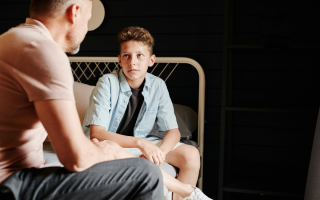
For children, separation arrives with a flood of questions that are rarely asked out loud. Where will I live? Will I still see both of my parents? Will we have to move house? Will I have to change schools? Do I have to choose?
These questions sit in a child's mind, whether or not anyone has given them a space to ask them, and when they go unasked and unanswered, children fill the silence with their own conclusions, which are almost always more frightening than the truth.
A child who has been given space to ask their questions is a child who no longer has to carry them alone. That difference matters more than most people realise.
Separating as a couple without separating as parents
Ending a relationship as a couple does not end the relationship as parents. Two people who are no longer together will remain connected through their children for the rest of their lives.
The quality of that connection – not whether it is warm or close, but whether it is functional and safe – will shape their children's experience of the separation more than almost anything else. Research is consistent on this point: it is not the separation itself that causes lasting harm to children. It is the conflict that surrounds it.
Family therapy helps separating parents build a co-parenting relationship that is separate from the couple relationship – one that does not require friendship or forgiveness, but that does require enough functional communication to parent effectively.
When the separation is behind you, but the challenges aren't
For many families, the most difficult period is what comes after it. The legal arrangements are in place. The two households exist. And yet the challenges have not resolved; they have simply changed shape.
Children moving between two households are navigating two different emotional atmospheres, two different sets of rules, two different versions of family life. They adapt, often with remarkable resilience, but adaptation is not the same as thriving. And when the two households are in tension with each other, that adaptation comes at a cost.
For many separated families, conflict does not end with the separation. It simply becomes the new normal – a chronic low-level tension that children absorb even when nothing is said directly.
As children grow, the arrangements that once worked stop working. Renegotiating them requires separated parents to communicate effectively, and that communication regularly breaks down, not because either parent is unreasonable, but because the emotional history between them makes even practical conversations loaded.
Blended families and the complexity of what comes next
For many separated families, the reorganisation does not stop with two households. New relationships arrive, new partners become part of the picture, and the family structure shifts again. The arrival of a new partner reactivates dynamics that may have felt settled.
Children who had adapted to their new family structure may find that adaptation destabilised. Questions of authority, belonging, and identity arise in ways that are rarely straightforward.
Family therapy supports families through these transitions, not by prescribing a particular shape that a family should take, but by helping everyone in the system find their footing in whatever shape the family is actually becoming.
When to seek support
There is no wrong time. Support is relevant at every stage – before, during, and long after the legal arrangements are in place.
Families that go through separation do not all go through it the same way. Some separate with relative calm; others in crisis. Some co-parent functionally from the beginning; others spend years in conflict. Some children adapt with resilience; others carry the weight of what their parents could not resolve.
What makes the difference, more than the specific circumstances of the separation, is whether the family has support to navigate the reorganisation.

Find the right counsellor or therapist for you
All therapists are verified professionals