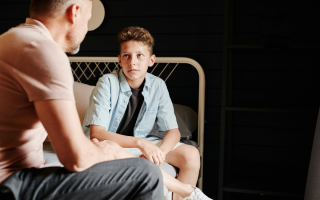
Complex family dynamics and their lasting impact

You have built a life that works. A career, relationships, and a degree of stability that your younger self might have found reassuring. And yet something persists underneath all of it, a feeling that is difficult to name, a pattern that keeps repeating in your closest relationships, a critical inner voice that no amount of external success quite silences.

You function well, you are capable, and often the person others rely on. Yet privately, something feels unresolved, with the sense that it has been there for a long time.
For many people, that unresolved something has its roots in the family they grew up in. Not necessarily in obvious harm or dramatic rupture, but in the subtler dynamics of a family system that shaped how they learned to relate to themselves and others before they had any language for what was happening.
Understanding those dynamics, not to assign blame but to make sense of patterns that have followed you into adult life, is often the beginning of something genuinely significant.
The dynamics that shape us
Family systems develop their own internal logic, their own rules about which emotions are acceptable, whose needs take precedence, and what each member is expected to provide.
These rules are rarely spoken aloud. They are communicated through the texture of daily life, through what is responded to and what is ignored, through what is celebrated and what is met with silence or withdrawal. Children absorb these rules before they are old enough to question them, and they organise their sense of self around them in ways that persist long after the family home has been left behind.
Enmeshment
Enmeshment is one of the most common and least recognised of these dynamics. In an enmeshed family, the boundaries between individual members are so dissolved that a child's separate feelings, needs and perspectives come to feel like a threat to the family's cohesion. The child learns, without anyone needing to say so directly, that emotional independence risks the withdrawal of love or belonging.
The adult who grew up in this environment often finds themselves highly attuned to the needs and feelings of those around them, sometimes to an extraordinary degree, while remaining genuinely uncertain about what they themselves need or feel. That uncertainty is not a personal failing; it is the predictable consequence of growing up in a system that did not have much room for a separate self.
Parentification
Parentification operates differently but leaves similarly lasting marks. When a child is required, through the unspoken logic of the family, to take on emotional or practical responsibilities that belong to the adults around them, something important is interrupted.
The child who becomes a parent's confidant, emotional regulator, or primary support does not simply grow up faster; they grow up without the experience of being adequately held, of having their own needs taken seriously.
In adulthood, the legacy of parentification tends to show up as a deep competence in caring for others alongside a profound difficulty in allowing care to flow the other way towards themselves. Being needed feels safer than being known.
Covert dysfunction
Covert dysfunction, the kind that operates beneath the surface of a family that appears perfectly functional to the outside world, presents its own particular challenges. These are families in which the gap between public presentation and private reality is managed through silence, performance, or the assignment of particular roles to particular children.
One child becomes the family's success story, another absorbs its difficulty, and a third learns to be invisible. These roles are rarely chosen; they are assigned by the system and reinforced over the years until they feel like an identity rather than an adaptation.
The person who spent their childhood being the capable one, the one who held things together, often arrives in adult life still holding things together, still performing competence, still unable to put the weight down, because they have never been shown that putting it down is allowed.
How these patterns travel into adult life
The relational patterns established in families of origin do not remain contained within the family. They travel into friendships, into working relationships, into intimate partnerships, into the relationship a person has with themselves. They shape the kinds of dynamics that feel familiar and therefore comfortable, often without any conscious awareness that this is happening.
An adult who grew up in an enmeshed family may find that intimacy at close range feels suffocating, or alternatively that they recreate the dynamic in their own relationships, becoming the emotional centre that everyone orbits around. Someone with a parentified history may find that the caretaking role establishes itself so naturally and so quickly in new relationships that it is fully in place before any deliberate choice has been made, and the exhaustion and resentment that follow can feel shameful, particularly when the care itself was genuinely offered.
The inner critic is another common inheritance from complex family systems. A child who grew up in an environment where love was conditional on performance, where mistakes were met with criticism or withdrawal, or where certain aspects of their authentic self were implicitly unacceptable, tends to internalise those responses. The critical voice becomes internal, often operating with more persistence and less mercy than the original ever did, presenting as self-knowledge, as an accurate assessment of shortcomings, when it is in fact a learned adaptation to a particular relational environment that made sense in context and has long since outlived its usefulness.
Family systems also shape what might be called emotional grammar: the rules, spoken and unspoken, about which feelings are permissible, how they may be expressed, and what consequences follow when they are not. People who grew up in families where certain emotions were prohibited, anger most commonly, but also grief, desire, or need, tend to find those emotions difficult to access, tolerate or express in adult life.
They may present as highly rational, as remarkably contained, or as prone to sudden, overwhelming feelings that seem to arrive without warning, because the emotion has had no ordinary outlet and no ordinary language.
What understanding these patterns makes possible
Recognising the patterns that family systems install is not the same as blaming the family that produced them. Most parents were doing their best within their own limitations, their own unexamined histories, their own unmet needs, and understanding where patterns came from does not require a verdict on anyone. What it does require is a willingness to look honestly at what was shaped in you, and at how that shaping continues to operate in your present life.
Relational psychodynamic therapy works directly with these patterns by attending to how they continue to show up in the present, including within the therapeutic relationship itself. The relationship between therapist and client is not incidental to this work. Because the patterns formed in early relationships tend to replay themselves in later ones, the therapeutic relationship becomes a live context in which those patterns can emerge, be noticed, and gradually understood from the inside.
A therapist who remains curious and non-reactive when defensive patterns activate, who can hold the complexity of a client's experience without needing to simplify or resolve it, offers something that may be genuinely new: a relational experience that does not simply confirm what the original family system taught.
For people who grew up in complex family systems and have spent years functioning well while privately carrying something unresolved, the experience of being genuinely known, of having the more defended and hidden parts of themselves met with curiosity rather than judgement, can be quietly but significantly transformative, opening up a different relationship with the present in which the patterns that once felt fixed begin to feel, slowly and with time, more like choices.

Find the right counsellor or therapist for you
All therapists are verified professionals