The world went back to normal, but you didn’t

The pandemic ended, officially, somewhere around 2022. The restrictions were lifted. The offices refilled. People started going to weddings and concerts again, booking holidays, and complaining about commutes with the vague relief of someone complaining about normal things.

And somewhere in the middle of all that, a different kind of movement gathered pace. Cold plunge pools. Breathwork. Cortisol protocols. Andrew Huberman explaining your nervous system to millions of people who’d never previously thought about their nervous system. The Diary of a CEO. GLP-1s going mainstream. An entire cultural obsession with optimising the body, resetting the biology, fixing from the inside out.
The world didn’t just go back to normal. It went aggressively forward, which makes it harder to explain why you’re still not feeling "quite right".
What “it’s over” doesn’t account for
There’s a particular kind of suffering that’s difficult to hold onto when the official story has moved on. You know it’s been years. You know that other people seem fine. You’re aware, on some level, that still feeling affected by the pandemic makes you look like someone who hasn’t kept up.
So you don’t say it. Or you frame it carefully – you’re just tired, you’ve been stressed, you think you might be burning out. You don’t connect it to 2020, because that seems excessive. Self-indulgent, even. But the connection is often real.
The pandemic didn’t end in a way that allowed for processing. It ended in a way that required forward momentum. And forward momentum, while useful for rebuilding, doesn’t leave much room for sitting with what actually happened.
The grief that got postponed
Many people lost someone during the pandemic and couldn’t grieve them properly. No gathering. No funeral with three hundred people who loved the same person. A video call instead, if you were lucky. The practical demands of continuing to function while everything was already strange.
Grief needs witnesses. It needs ritual. It needs the particular relief of being in a room where other people are also bereft, where you don’t have to explain why it matters. Most people didn’t get that. They got survival mode instead.
And survival mode is efficient, but it’s not free. It borrows against later. The grief that couldn’t be felt in 2020 or 2021 didn’t go anywhere – it just waited. And now, years later, it surfaces in unexpected ways. Disproportionate reactions to small losses. A heaviness that has no obvious cause. Tears at something that isn’t, on the face of it, sad enough to warrant them.
This isn’t weakness or delayed damage. It’s ordinary grief doing what grief does when it’s been kept waiting.
The identity that didn’t survive
Beyond bereavement, there’s something else that’s harder to name. There’s the disorientation of time. Two or three years passed without the usual markers – the holidays, the milestones, the ordinary accumulation of events that give a year its shape.
For some people, this falls across a significant passage: their children’s early years, a decade they’d expected to build something in, a window of youth that didn’t get used the way they’d imagined. The years aren’t recoverable. And there’s a specific kind of grief in that, distinct from losing a person – a mourning of time itself, of the life that was supposed to be happening while everything was on hold.
There’s also the loss of who you were in it. A career trajectory that made sense. A version of your social self that required regular practice to maintain. A sense of place in the world – at a desk, in a building, among colleagues, in the fabric of a city that had rhythm and texture. Much of that got stripped away. And when it came back, it didn’t quite fit in the same way.
Some people changed fundamentally during those years and haven’t caught up with the change. The person who used to thrive in a busy office now finds it draining. The person who was socially confident finds themselves exhausted by obligations they once looked forward to. They’re functioning, but they’re doing it as a slightly different person than the one they thought they were, and nobody’s really talked about that.
The wellness response and what it’s doing
This is where the cold plunge pools come in. The self-optimisation boom that followed the pandemic makes a certain kind of sense. COVID made bodies feel unreliable. It made mortality feel arbitrary. It generated a level of low-grade physiological stress that lasted, for many people, far longer than the acute phase of the crisis.
So the turn towards breathwork, nervous system regulation, and biological hacking – that’s not random. It’s people trying to feel safe in their own bodies again. Trying to claw back some sense of control over something that felt wildly out of control. There’s nothing wrong with that impulse. Some of those practices are genuinely useful.
But there’s a version of the wellness response that functions more like avoidance than repair. If the underlying problem is unprocessed grief, or a fractured sense of identity, or a social self that quietly atrophied – no amount of cold exposure fixes that. It just gives the anxiety somewhere to go.
And the anxiety, once it has somewhere to go, feels more manageable. Which is not the same as being resolved.
What helps
The thing that tends to help is, unfortunately, the thing that’s harder to turn into a protocol.
It’s being able to say: the pandemic affected me, and I haven’t fully dealt with what it took. It’s naming the specific losses, not just the dramatic ones, but the quieter ones. The graduation that happened over Zoom. The friendships that quietly ended without either person choosing to end them. The version of yourself that existed before March 2020 and didn’t quite come back afterwards.
It’s allowing that these things matter without immediately arguing yourself out of it because other people had it worse, or because it was years ago, or because you should be over it by now. You don’t have to be over it. There’s no timeline for this kind of thing.
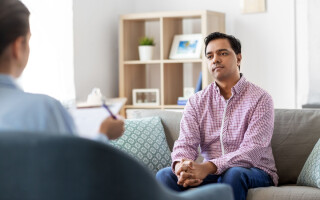
What therapy offers in this context isn’t a protocol either. It’s a space where the story of those years can actually be told – properly, with someone who isn’t also exhausted by their own version of it. Where the losses can be named and felt, rather than managed and moved past.
The world went back to normal. That doesn’t mean you have to pretend you did too.

Find the right counsellor or therapist for you
All therapists are verified professionals