

Outdoor therapy: what to expect and why try it

Counsellors are increasingly offering sessions outdoors and research shows how beneficial being out in nature can be for our mental health.
This article explores some of the possibilities of what therapy out in nature might look like, why you might choose it and what you might want to know when you’re exploring your options.
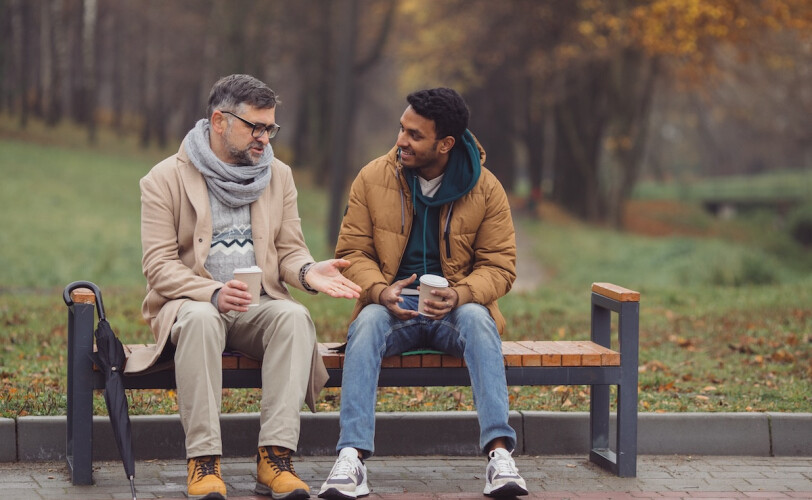
What is outdoor therapy?
Walk and talk, nature therapy, outdoor sessions, ecotherapy – multiple terms may be used to refer to therapy outdoors and they might mean different things to different people.
It might help to think of it as a continuum. At one end, there is therapy that might be pretty similar to what happens in a traditional counselling room but just happens to be outdoors. The main connection is between you and your therapist, with nature staying in the background.
At the other end, there is therapy in which you are invited to immerse in the natural environment, relating directly with the plants, creatures and elements around you. Nature is fully present alongside you and your therapist.
Different approaches to therapy outdoors
Of course, nature sometimes makes itself hard to ignore – the bright blue of a kingfisher flitting along the canal as you stroll along the towpath, turning a corner in the path to be met with a sunset glowing through bare winter trees. These are likely to make both you and your therapist stop and say ‘wow’.
But those moments themselves can be received in different ways. Are they seen as an interruption to what you were saying? Or are they part of the therapy itself – moments of connection with a world larger than ourselves, a world full of wonders?
When you move beyond seeing nature as a backdrop, many small moments can offer significance. A fork in the path may mirror choices you are making in life or routes your past self left behind. How you and your therapist negotiate narrow paths may provide clues to how you interact with others.
We often talk about our lives and emotions using natural metaphors. We let some things go like autumn leaves. We move with the flow like water in a stream. We sow seeds of new possibilities. We grow from our roots and the soil they find themselves in, which may be rich or depleted, nourishing or toxic. We can find ways to improve our conditions, adding nourishing compost around those roots.
What are the benefits of outdoor therapy?
Mental health and nervous system benefits
You might want to gain the proven benefits of being out in natural environments. These include regulation of the nervous system – it seems that if we are feeling anxious, nature will help us to calm, and if we are feeling low, it will help us to energise. Research has also found nature to be beneficial for cognitive function, our moods, our self-esteem and our immune systems.
You will get these benefits whatever the sessions themselves actually look like simply from being out in green spaces, even at that end of the continuum where a session feels very much like one that could take place indoors.
Movement and accessibility
You may also get the added benefits of the movement of walking, which is known to boost cognitive function. On the other hand, outdoor counselling does not have to involve walking. You may choose to sit and some sites will be accessible to people using a wheelchair or other mobility aids.
But you may also want something at the other end of the continuum. A wider feeling of connecting with something bigger than our individual selves, a sense of belonging in the world, a reminder that we, too, are nature and have our place in the ecosystem. The theory of ‘biophilia’ gives us a way of understanding this: it suggests we feel an innate bond with the natural world, a connection that is vital to our wellbeing.
Practical considerations before starting
Weather and flexibility
There’s all the practical stuff you may want answers to before embarking on outdoor therapy. You might want to know what happens if it’s pouring down, or very windy, or icy. Is there a back-up plan of a traditional therapy room or perhaps going online? Likewise, what if you’ve twisted your ankle or have a bad cold and just don’t feel like heading out?
Accessibility and location
Some therapists will always use the same site; others will move between several or consider new ones in negotiation with clients. Some sites will be easy under foot or have surfaced paths suitable for a wheelchair, while others may be rougher, steeper, muddier. What suits you?
Confidentiality and privacy outdoors
You might also consider the difference around the issue of confidentiality between traditional counselling and outdoor sessions. Outdoors, there is always potential for other people to be nearby. It’s certainly worth both you and your therapist considering how you might manage that – can you be flexible with routes to avoid groups of walkers, can you pause if necessary and how would you feel about getting visibly emotional in front of passers-by?
Is outdoor therapy right for you?
Health and safety considerations
Health and safety is another consideration – in a therapy room you’re not far from help if you have an urgent physical or mental health issue. There’s likely to be mobile reception and an ambulance can get to the door. Outdoors, it may be trickier to get emergency help. Do you have health issues that make this a concern? Some first aid courses focus on preparing for emergencies in remoter areas – do you want your therapist to have this kind of training?
Working with the natural environment
Then there’s the deeper stuff. You might like to ask a potential therapist how much they tend to bring the surrounding environment into the therapeutic work. Is there the potential to work with specific features such as a tree or a stream or to get hands on with natural materials creatively if you choose to? How might you like your therapist to respond to a sudden sighting of a squirrel, or a funky looking mushroom?
Reflecting on your relationship with nature
It may be useful to consider your own past relationship with nature – your ‘natural history’, as it were. Has the outdoor environment been a safe place for you in the past, or has it been a place where you have experienced threat or trauma? Does it bring up particular childhood memories or significant moments in life and are you ready to bring these into your therapy?
Final thoughts
Stepping out of the door for your therapy sessions may seem a simple move and in many ways it is. It’s where we evolved to be, after all. But it can also bring new dimensions of depth and connection to your therapy – and unexpected surprises that don’t tend to happen so often in a traditional counselling room.
If you’d like to explore this approach further, you can look for counsellors who offer outdoor therapy and have a conversation about what it might involve for you.

Find the right counsellor or therapist for you
All therapists are verified professionals


