

Essays on love: The things we can learn from deer

Let me tell you a beautiful story about the baby deer and the quiet way it comes into the world. Its story can teach us about love, distance, and the meaning of closeness from a psychoanalytic perspective.
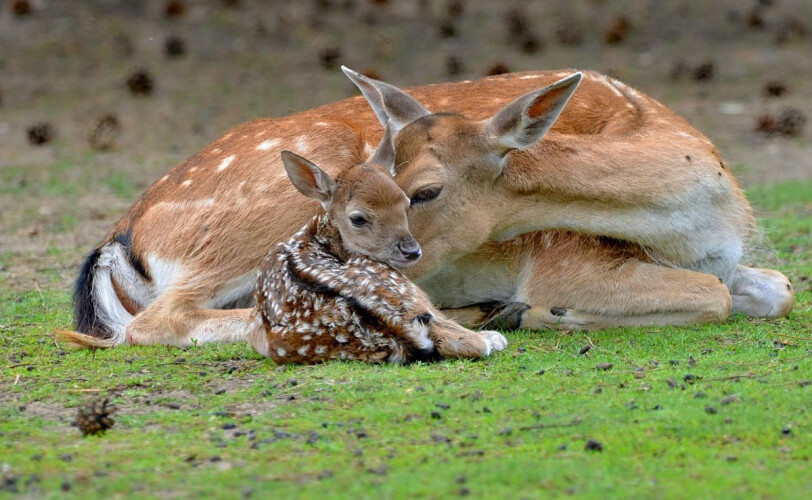
Did you know that when the mother deer gives birth, she doesn’t stay too close to her young? In fact, she leaves them alone for hours at a time. Because of this, to anyone walking through the forest, it might look as if the baby deer were abandoned. We see this small creature, with its body lying still in the grass. The mother deer is nowhere in plain sight. We tend to assume and see a fragile creature waiting, and very often, passersby think it needs help.
This is an important lesson about how survival works. You see, baby deer are born without a scent, and this is nature’s way of keeping them invisible to other wild animals. The mother, on the other hand, carries a very strong smell. If she stayed too close, her very love would end up hurting her babies. Knowing that, she always watches from afar. She is always near enough to protect them, but distant enough to let them live.
The baby deer remains still, silent, as it learns this ancient lesson: that sometimes love doesn’t come from closeness, but from keeping a safe distance. This story stayed with me, not because of what it says about animals, but most importantly because of what it can reveal about human connectedness.
In Western culture, we often consider that love means holding on. We think about love in terms of staying near, staying constant, and focus on the principle of never letting go. But what if love, the kind that truly protects… sometimes asks for space?
In this respect, psychoanalytic theory has always circled around this paradox of the tension that exists between closeness and separation and the way we deal with either of these two relational conflicts. We often see people struggling with getting close to someone or struggling with being away from someone. These are two of the most basic conflicts that define the way we form relationships with others, and surprisingly, both are a response to our fear of rejection and abandonment.
The earliest bonds we form can be both beautiful and dangerous at the same time. For example, the infant clings to the mother for life, yet must one day bear the pain of distance to become a self on its own. If we have too much closeness, it smothers us, and if we have too much distance, it can wound us. It is somewhere in that in-between, in that uncertain, trembling middle space that this is where growth happens.
The mother deer knows this instinctively. It would be unfair to consider her absence as neglect. Her absence is a kind of faith that her baby can remain still, can endure, and can wait. And isn’t that what so much of love really is? Trusting that someone can exist without your constant presence and vice versa. It is in trusting that your bond can hold, even across silence.
From a psychoanalytic point of view, closeness often hides another impulse of our need for control, and distance acts in a similar way. We stay near not only to protect, but to soothe our own fear of loss. We stay close to make sure nothing changes. But the mother deer undoes that fantasy. She knows her nearness could destroy what she most wants to save. Therefore, her distance is not about rejection. It’s restraint born out of love.
A love that trusts the unseen connection. That’s what analysts sometimes call good distance. It is the space that allows the other to breathe, to become, to live. I do not want this to be confused with the type of distance that does not allow for any relationship to form, but more of an ability to tolerate the anxiety of someone not being close all the time, without becoming reactive.
Maybe that’s what the deer is teaching us. It teaches us that love isn’t always about holding close. Sometimes it’s about learning to watch from afar. Sometimes it is to say: I’m here, even when you can’t see me. I trust you to exist, and I want you to do the same.
In this respect, the truest kind of closeness is born from the courage to step back at times. Mother deer knows that when you love something… sometimes, you need to let it go.

Find the right counsellor or therapist for you
All therapists are verified professionals


