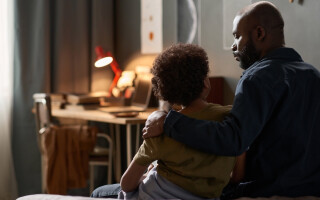
When grief grows up with you: childhood bereavement in adulthood

Losing a parent as a child, or experiencing any significant bereavement in childhood, doesn't end when you grow up. For many adults, the effects of losing a parent in childhood surface quietly for years: in the way grief sits differently to other people's, in the anniversaries that catch you off guard, or in relationships that carry an unexpected weight.

If any of that feels familiar, it's worth knowing that what you're carrying is real, and that it can be worked with.
What are the long-term effects of losing a parent in childhood?
Childhood bereavement can shape how adults experience loss, relationships and self-worth in ways that aren't always easy to trace back to their source. The grief of a child often goes underground rather than being fully processed, and it tends to resurface during significant life events, losses, or major transitions in adult life.
When a parent dies during childhood, a child is grieving with a brain and emotional system that isn't yet equipped to process that loss fully. That's not a failure – it's simply how development works. Children typically grieve in bursts rather than waves. They carry on going to school, laughing at things, seeming fine, and the adults around them, also in grief, often take that as a signal that the child is coping. Sometimes they are. Sometimes the grief just gets stored, waiting for a moment when the nervous system feels safe enough, or stretched enough, to bring it forward.
The effects that can emerge in adulthood include a heightened sensitivity to loss or abandonment, difficulty trusting that relationships will last, a persistent sense of difference from people who haven't experienced early loss, and complicated grief responses when other losses occur later in life. Some people notice they struggle with milestones – graduations, weddings, becoming a parent themselves – because those moments make the absence feel suddenly present again.
Why does childhood grief feel different when you're an adult?
Adults who were bereaved as children often describe grief that doesn't quite match the pattern they'd expect. That's partly because they're grieving two things at once – the person who died, and the child they were when it happened. Counselling can offer space to hold both of those experiences, not just the loss itself.
There's a particular kind of grief that comes with going back to something you never fully mourned. It doesn't feel the same as fresh loss. It can feel more like confusion, a low-level sadness with no obvious current cause, or a reaction to something that seems disproportionate to those around you.
Part of what makes childhood bereavement complex is that the grief has been filtered through decades of ordinary life. You may not have a complete picture of the person who died – you might only know them through the stories of others, a handful of memories, or photographs. You're grieving someone you didn't fully get to know. And alongside that, you may also be grieving a version of your own childhood that changed the day they died.
This is grief with layers, and it's worth treating it as such rather than expecting it to resolve the way a more recent loss might.
How bereavement support can help
Bereavement support for adults carrying childhood loss isn't about revisiting the past for its own sake. It's about understanding how that early experience has shaped the present and finding ways to carry it that feel less like a burden and more like a part of who you are. Many people find that even a few sessions can shift something that has felt stuck for a long time.
Counselling doesn't ask you to re-experience the grief as if it just happened. What it can offer is a space to look at the patterns it's left – in how you relate to others, how you respond to loss, how you cope with uncertainty – and to understand them with an adult perspective.
Some people find it helpful to finally talk about the person who died in a way they couldn't as children, not to perform grief, but simply to acknowledge that the relationship mattered and deserved to be honoured. Others find that the work is more about the present: understanding why a particular relationship or situation feels impossibly fraught, and tracing it back to something that makes sense.
There is no single right way to work with childhood bereavement. What matters is finding an approach that fits you – one that doesn't rush you, that takes the complexity seriously, and that treats your experience as exactly that: yours.
Is it too late to get support for grief from childhood?
It is never too late. Grief doesn't have a statute of limitations, and neither does the support available for it. Adults seek bereavement counselling after decades of carrying a loss and find it genuinely useful. The only relevant question is whether it feels like the right moment for you.
People sometimes come to grief counselling in their thirties, forties or fifties, not because something catastrophic has happened, but because they've reached a point where they want to understand themselves better. A parent's anniversary. A child of their own reaching the age they were when they were bereaved. A quiet sense that something unfinished is taking up space.
Those are all good enough reasons. The timing doesn't need to be explained or justified. Grief work can happen at whatever point it feels right to begin. If you're an adult who experienced bereavement in childhood and you'd like to explore what support might look like, reach out.

Find the right counsellor or therapist for you
All therapists are verified professionals